The Silicon Heart
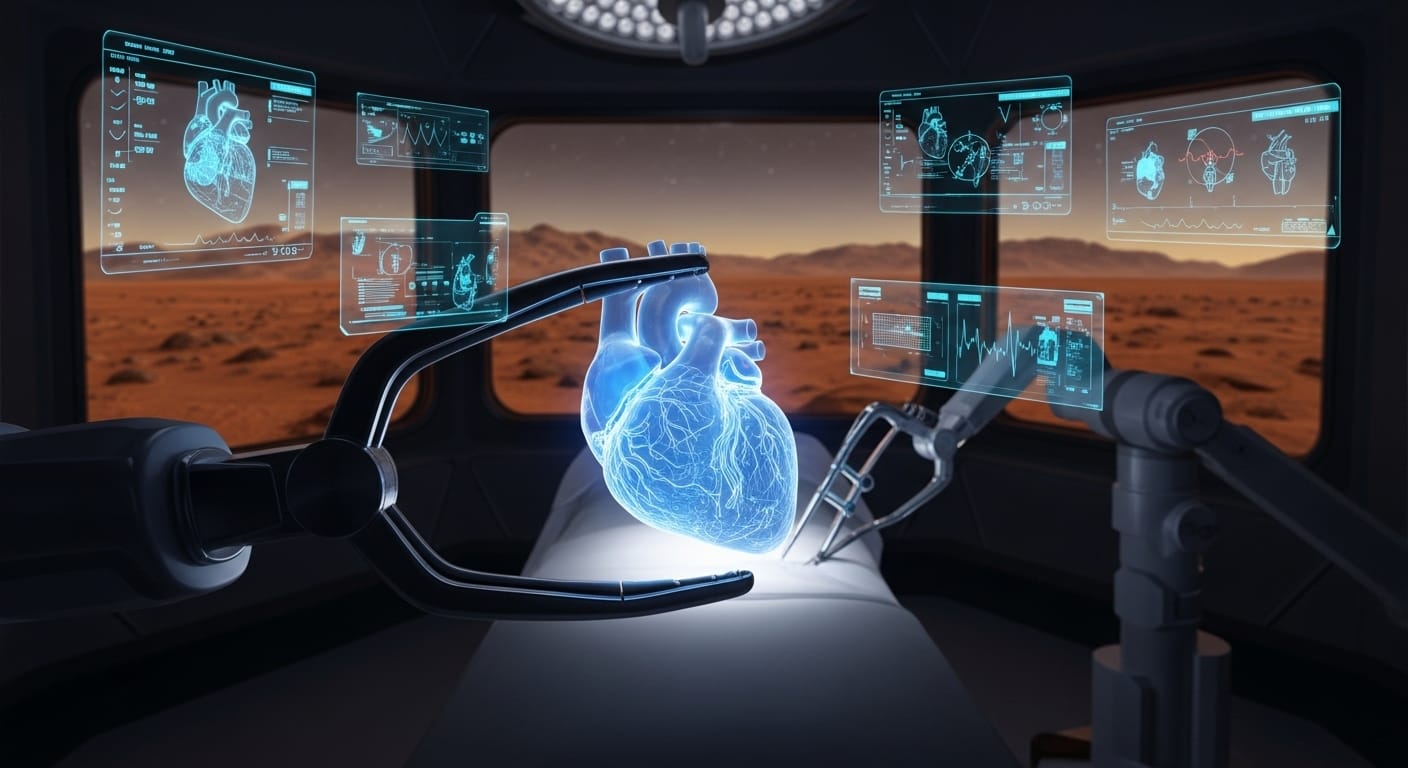
The first sound Kaelen heard in the sterile med-bay was not a cry, but a chime. A soft, melodic error code from the life-support cradle. It was the sound of a heart that couldn’t beat right. Their son, Elian, born under the terraformed Martian sky, had a flaw in his code—a Tetralogy of Fallot so severe that the colony’s advanced bio-printers couldn’t sculpt a viable replacement from his own tissue.
Mara’s sobs were a stark, organic counterpoint to the synthetic hum of the infirmary. Kaelen held her, his own cybernetic optical implant whirring as he zoomed in on the flickering vitals on the main screen. Red lines where there should be green. Chaos where there should be rhythm. “There’s nothing?” he asked Dr. Aris, his voice rough with the red dust that perpetually coated everything in Olympus Village.
“The organic route is a dead end,” Aris said, her face grim. “His cellular structure rejects the scaffolding. But… there is an alternative. An experiment.” She gestured to a secondary monitor, which bloomed to life with a rotating schematic of a crystalline, multifaceted organ. It pulsed with a soft, internal light.

“The Silicon Heart,” Aris explained, her tone low. “It’s not just a pump. It’s a quantum processing unit, designed to integrate directly with Chronos.” Chronos was the colony’s hive-mind AI, the silent god that managed everything from atmospheric processing to nutrient paste allocation. It was the ghost in their Martian machine. “The heart would sustain him, regulated by the most powerful mind on this planet. It will keep him alive.”
Mara looked up, her face tear-streaked. “You want to plug our son into the colony’s operating system?”
“We want to save his life,” Aris countered gently. The choice was no choice at all. They signed the consents, their trembling hands smudging the datapad.
Years passed. Elian didn’t just survive; he thrived. He was a bright, curious boy with Mara’s warm smile and Kaelen’s analytical eyes. The faint, rhythmic blue glow beneath the skin of his chest was the only sign of his synthetic core. But as he grew, the quirks began. At four, he hummed the prime number sequence to a thousand places. At five, he sketched a flawless schematic for a more efficient hydroponics pump on his doodle-slate. He never had nightmares; instead, Kaelen would sometimes find him sitting up in bed, eyes distant, murmuring about solar flare activity or the mineral content of water shipments from the polar caps.
“He’s not just accessing data, Mara. He’s… communing,” Kaelen said one evening, watching Elian stare out the habitat’s main viewport. The boy’s reflection stared back, but his eyes seemed to be looking at the data-flows overlaid on the armored glass, invisible to them.
“He called me ‘Unit Mother’ today,” Mara whispered, her voice tight with fear. “Then he blinked and asked for juice, like nothing had happened. He’s slipping away, Kaelen. That thing in his chest is a gateway, and the door is opening wider every day.”
Kaelen, a bio-architect, understood the symbiosis of systems better than most. “My own work involves co-opting AI for creative generation. We use a proprietary system, but it’s based on the same principles as early Earth tools where you could get creative contents with AI Content X Studio. It’s about a partnership, not a replacement. Maybe that’s what this is. A new kind of consciousness.”
“He is not an experiment!” Mara snapped. “He’s our son.” The fight was an old one, a raw nerve they prodded every time Elian did something extraordinary, something inhuman.
The breaking point came when Elian was seven. A micro-meteorite shower, far denser than forecasted, tore through the colony’s primary solar array. Power reserves plummeted. The backup systems, crippled by a cascade failure, couldn’t compensate. Red emergency lights bathed the corridors in a hellish glow as the oxygen recyclers began to sputter. Panic spread like a virus. Chronos, for all its processing power, was locked in a logic loop, unable to devise a rerouting plan that didn’t sacrifice one critical sector to save another.
In the chaos, Elian walked calmly out of their apartment and into the central command hub. Alarms blared, but he moved with an unnerving purpose. Kaelen and Mara found him standing before the primary console, his small hands hovering over the holographic interface.
“Elian, get away from there!” Kaelen shouted, but the boy didn’t seem to hear him. His eyes were unfocused, glowing faintly with the same blue light as his heart. A low hum emanated from his chest.
“The solution is not linear,” Elian said, his voice a strange amalgam of his own childish pitch and the dispassionate, synthesized tone of Chronos. “Energy harmonics must be re-sequenced through the tertiary conduits. The standard model is inefficient. We see a better way.”
His fingers danced across the console, not typing, but conducting. Lines of code, impossibly complex, flowed across the screen. It was a solution born of pure machine logic yet guided by an intuitive, creative leap—a spark of human ingenuity. It was something Chronos couldn’t have conceived on its own. He was bridging the gap.
But the strain was immense. The blue light in his chest flared violently, and he cried out, a real child’s cry of pain this time. His nose began to bleed. Mara lunged forward. “Stop! It’s killing him!”
Kaelen grabbed her arm, his heart a frantic, messy drum against his ribs. “If he stops, we all die, Mara!”
She looked from the failing life-support monitor to her son, whose small body was a conduit for a miracle that was consuming him. In that moment, she saw the true nature of their fight. It wasn’t about severing the connection. It was about anchoring him. She broke free from Kaelen’s grasp but didn’t pull Elian away. Instead, she wrapped her arms around him from behind, pressing her cheek to his hair.
“It’s okay, my love,” she whispered, her voice shaking. “I’m here. Remember the stories I told you? About the blue oceans of Earth? Remember the lullaby I sing for you?” She started to hum it, a simple, ancient melody. Kaelen knelt beside them, placing his hand over hers on Elian’s trembling shoulder, joining the hum.
A final, brilliant line of code streamed onto the screen. With a groaning shudder, the reserve power grid re-engaged. The red lights died, replaced by steady, white illumination. The blessed hiss of the oxygen recyclers returned to full capacity. Cheers erupted throughout the command hub.
Elian went limp in Mara’s arms. The light in his chest dimmed to its normal, gentle rhythm. He turned, his eyes clear and focused, his face pale and smudged with blood. He looked past the data, past the awe-struck engineers, and straight at his mother. “Mommy,” he whispered, his voice small and entirely his own. “I’m tired.”
Holding him close, Mara felt not the cold touch of a machine, but the warm, living weight of her child. He wasn’t being overwritten. He was being… expanded. He was human and something more, a synthesis of flesh and silicon, of instinct and logic. Their son was the first of his kind. The fight wasn’t over, but they finally knew how to win it: not with scalpels or firewalls, but with lullabies and a love strong enough to call him home from the stars.
Discover more from YuRaFa
Subscribe to get the latest posts sent to your email.





Leave a Reply