The Odyssey of Minds: A Brief History of Artificial Intelligence
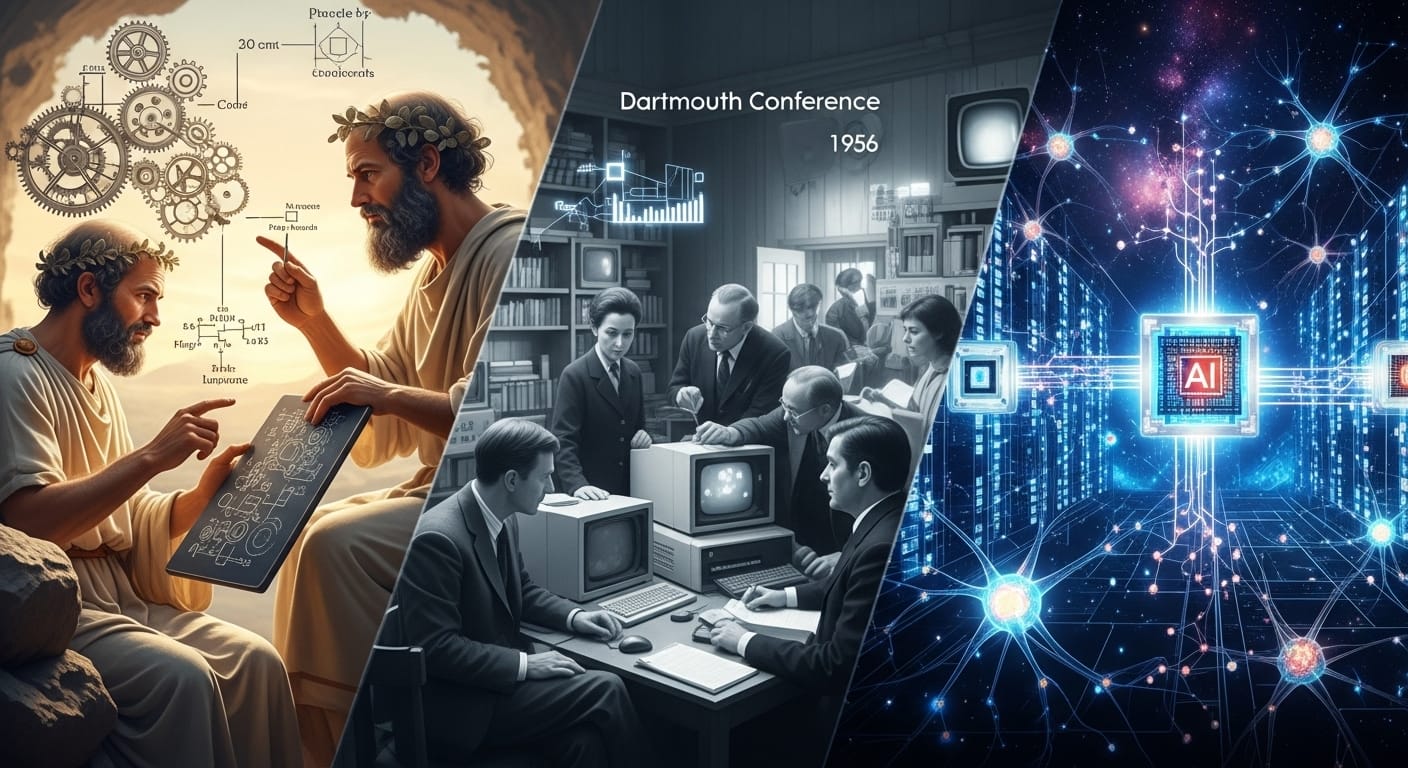
The Odyssey of Minds: A Brief History of Artificial Intelligence
Ever wondered how we got to a point where machines can paint, write, and even hold conversations? The journey of Artificial Intelligence (AI) is nothing short of epic, stretching from ancient philosophical musings to its current role as a transformative technology that’s literally reshaping our world. Buckle up, because we’re about to take a casual stroll through the fascinating history of AI!
It’s not just about robots taking over; it’s about centuries of human ingenuity trying to replicate or enhance our own intelligence. Let’s dive into the fascinating chapters of this ongoing story.

The Seeds of Thought: Early Concepts and Foundations
Believe it or not, the idea of artificial beings isn’t new. Ancient Greek myths told tales of automatons like Talos, a giant bronze man, and the Golem of Jewish folklore. These stories reflect humanity’s age-old fascination with creating life or intelligent entities.
- Ancient Philosophers: Thinkers like Aristotle laid the groundwork for logical reasoning, a core component of early AI.
- Mechanical Minds: Later, inventors like Leonardo da Vinci sketched designs for humanoid automatons, and even earlier, ancient civilizations had intricate mechanical devices.
- Computational Theories: Philosophers like Gottfried Leibniz envisioned a universal language of thought and mechanical calculators, hinting at the potential for machines to process information.
These early dreams and conceptual frameworks were the tiny seeds from which the mighty tree of AI would eventually grow.
The Dawn of AI: Symbolic Systems and Early Hype
Fast forward to the 20th century, and things really started to get interesting. The formal birth of AI is often pegged to a few pivotal moments:
- Turing Test (1950): Alan Turing, a brilliant mathematician, proposed a test to determine if a machine could exhibit intelligent behavior indistinguishable from a human. A groundbreaking concept that still sparks debate!
- Dartmouth Workshop (1956): This legendary summer workshop is where the term “Artificial Intelligence” was officially coined. Researchers gathered, brimming with optimism, believing AI was just around the corner.
- Early Programs: Pioneers developed programs like the Logic Theorist (proving mathematical theorems) and ELIZA (a simple chatbot that mimicked a psychotherapist). These were based on “symbolic AI,” relying on predefined rules and logical reasoning to simulate intelligence.
The excitement was palpable, leading to grand promises that, unfortunately, weren’t always met. This era, while foundational, eventually led to what’s known as the first “AI Winter,” a period of reduced funding and interest.

Through Winters and Revival: From Expert Systems to Machine Learning
The initial hype gave way to disillusionment, but AI didn’t disappear. It simply went underground, evolving and learning from its past. The 1980s saw a brief resurgence with Expert Systems. These were programs designed to mimic the decision-making ability of human experts in specific domains.
“Expert systems like DENDRAL (for identifying organic molecules) and MYCIN (for diagnosing blood infections) showed real-world utility, but their limitations—difficulty in scaling, rigidity, and the ‘knowledge acquisition bottleneck’—soon became apparent.”
Another AI Winter followed, but silently, a new paradigm was gaining traction: Machine Learning. Instead of explicitly programming rules, researchers began to focus on algorithms that could learn from data.
- Neural Networks: Inspired by the human brain, these algorithms started to resurface, though their computational demands were still a challenge.
- Statistical Methods: Techniques like support vector machines and decision trees offered more robust and data-driven approaches.
- Computational Power: As computers became more powerful and data more abundant, machine learning started to show its true potential.
This shift from “telling” machines what to do to “teaching” them how to learn was a game-changer, setting the stage for the modern AI revolution.
The Modern Revolution: Deep Learning and the Age of AI
And here we are, in the midst of arguably the most exciting period in AI history! The breakthrough of Deep Learning in the 2010s, powered by vast datasets and incredible computing power (especially GPUs), completely transformed the landscape. Deep neural networks, with many layers, could automatically learn complex patterns from raw data.
- Image Recognition: Deep learning revolutionized computer vision, allowing AI to identify objects in images with superhuman accuracy.
- Natural Language Processing: AI can now understand, generate, and translate human language with unprecedented fluency. Think chatbots, voice assistants, and smart text editors.
- Strategic Games: AlphaGo’s victory over the world champion in Go (a notoriously complex game) was a monumental moment, showcasing AI’s strategic prowess.
- Generative AI: The latest wave, with models like GPT-series for text and DALL-E for images, is enabling AI to create entirely new content, from compelling stories to stunning artwork. If you’re looking to tap into these creative AI capabilities, platforms like AI Studio offer tools to explore and generate AI content.
Today, AI is embedded in countless aspects of our lives, from personalized recommendations and medical diagnostics to self-driving cars and advanced scientific research.
Conclusion
From ancient dreams of artificial companions to the complex algorithms that power our smart devices, the history of AI is a testament to human ingenuity and an relentless drive to understand and replicate intelligence. It’s been a wild ride of ambition, setbacks, and breathtaking breakthroughs.
The journey isn’t over, of course. AI continues to evolve at an astonishing pace, constantly redefining possibilities and challenging our understanding of what intelligence truly means. What new chapters will we write next? Only time will tell, but one thing is certain: the odyssey of minds is far from complete.






Leave a Reply